First lunar month · turning animal year
Chinese New Year Dates 2024–2035: Animal-Year Boundaries
Chinese New Year 2026 falls on 17 Feb 2026, lunar month 1, day 1, opening 丙午 Yang Fire Horse. The 12-year register below runs from 2024 to 2035; Bazi uses the separate Li Chun boundary.
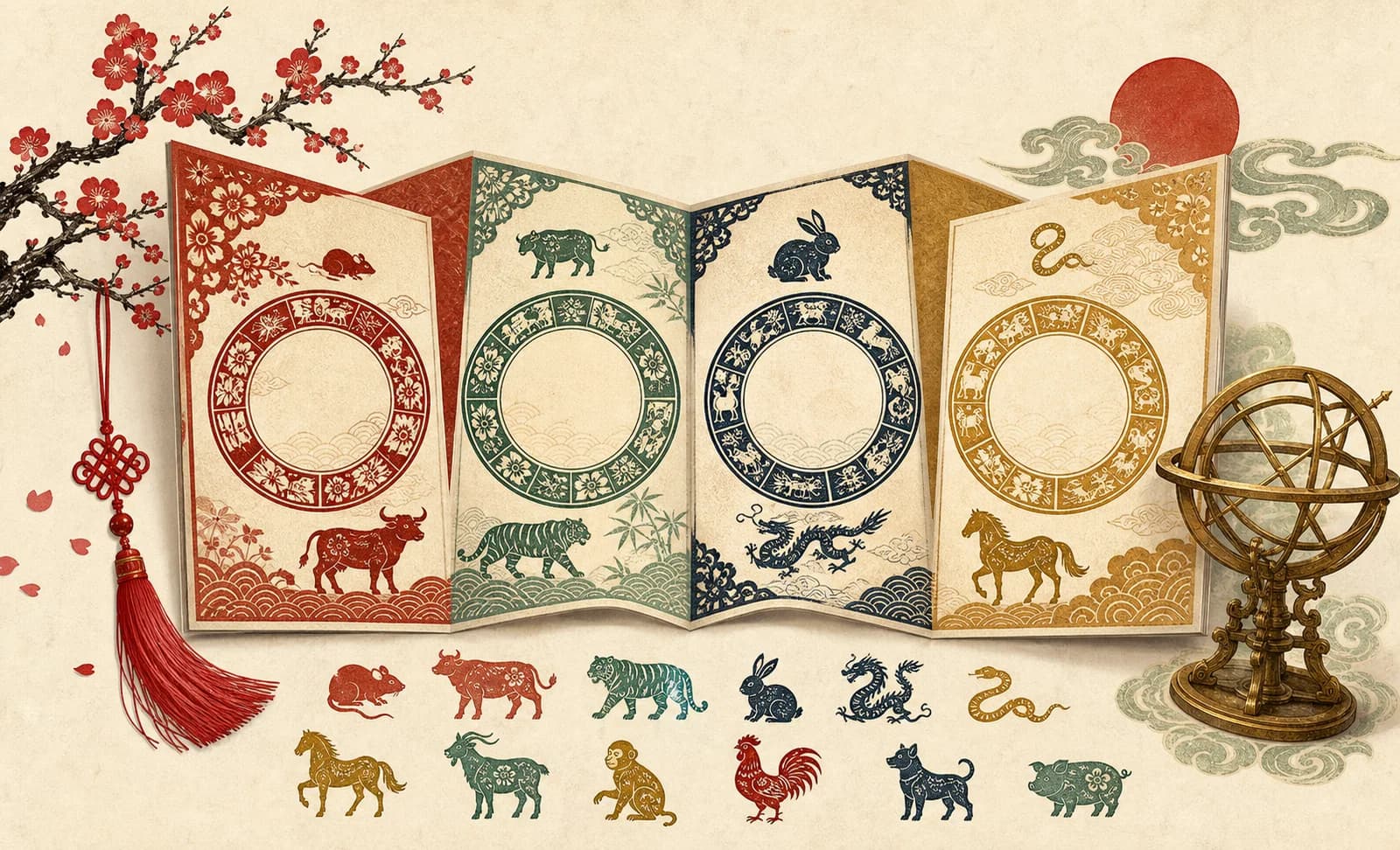
Verified date register
Chinese New Year dates and the years they open
Each row names the Gregorian date on which that zodiac year begins. The animal comes from the Earthly Branch; phase and polarity come from the Heavenly Stem.
- 甲辰2024 · Yang Wood DragonCycle position 41 of 60
- 乙巳2025 · Yin Wood SnakeCycle position 42 of 60
- 丙午2026 · Yang Fire HorseCycle position 43 of 60
- 丁未2027 · Yin Fire GoatCycle position 44 of 60
- 戊申2028 · Yang Earth MonkeyCycle position 45 of 60
- 己酉2029 · Yin Earth RoosterCycle position 46 of 60
- 庚戌2030 · Yang Metal DogCycle position 47 of 60
- 辛亥2031 · Yin Metal PigCycle position 48 of 60
- 壬子2032 · Yang Water RatCycle position 49 of 60
- 癸丑2033 · Yin Water OxCycle position 50 of 60
- 甲寅2034 · Yang Wood TigerCycle position 51 of 60
- 乙卯2035 · Yin Wood RabbitCycle position 52 of 60
Date coverage: 1901-2100, from the Hong Kong Observatory Gregorian-Lunar Calendar Conversion Table. See the site’s source register.
What turns—and what does not
One festival date, three different calendar questions
“The year changes” can refer to civil administration, the popular zodiac animal, or a Four Pillars coordinate. Keeping those questions separate removes most apparent conflicts.
- 01Gregorian civil year
Turns on January 1. It labels the date but does not settle a zodiac-year boundary.
- 02Outer zodiac animal year
Turns on Chinese New Year in this site’s popular year-animal result.
- 03Four Pillars year
Turns at Li Chun in the chart method used here, sometimes before and sometimes after the festival.
Moon months, solar seasons
Why the Gregorian date moves
Traditional months follow lunar phases, while leap months and solar markers keep the calendar aligned with the seasonal year. The same named lunar date therefore lands on a different Gregorian day from one year to the next.
A lunar month opens
The first day is tied to the new-moon phase rather than to a fixed Gregorian date.
Leap months correct drift
An extra lunar month is inserted when needed so month names do not slide through every season.
Solar terms hold the seasons
The Sun’s seasonal markers keep the lunisolar calendar anchored to the agricultural year.
The boundary in practice
One day changes the outer-year label
Compare the day before the festival with its first day. Nothing is inferred from January 1.
- 乙巳Yin Wood Snake
Zodiac year 2025
- 丙午Yang Fire Horse
Zodiac year 2026
- 丙午Yang Fire Horse
Zodiac year 2026
- 丁未Yin Fire Goat
Zodiac year 2027
A festival period, not one isolated moment
From reunion eve to the Lantern Festival
The calendrical boundary is the first day, while observance forms a longer arc. Customs vary by region and family, so the sequence below names only the broad temporal structure.
The old year closes with reunion and preparation.
The first lunar month opens and the outer zodiac-year label changes.
The first full moon closes the best-known public festival arc.
Questions around the turning year
Chinese New Year, clearly bounded
When does the Chinese zodiac animal change?
On this site’s popular outer-year reading, the animal changes on Chinese New Year. A birth before that date remains in the preceding zodiac year even after January 1.
Is Chinese New Year the same date every year?
No. It is the first day of the first month in the traditional lunisolar calendar, so its Gregorian date moves through late January and February.
Is Chinese New Year the Four Pillars year boundary?
Usually not. Four Pillars practice conventionally turns the year pillar at Li Chun, the Start of Spring solar term. The two boundaries can disagree for days or weeks.
Why can two websites give different animals for a February birthday?
They may be using different named boundaries. A reliable result should state whether it uses Chinese New Year or Li Chun instead of presenting the answer as boundary-free.