A river crossing in twelve arrivals
Chinese Zodiac Order: 12 Animals & the Great Race Story
Rat, Ox, Tiger, Rabbit, Dragon, Snake, Horse, Goat, Monkey, Rooster, Dog and Pig: read their order, Great Race story and place in the 12-branch cycle.
A widely told folktale describes a race or river crossing used to choose and order twelve animals. It is a cultural story with many retellings — not a dated historical record of how the branch system began — and it remains the most memorable way to learn the order.
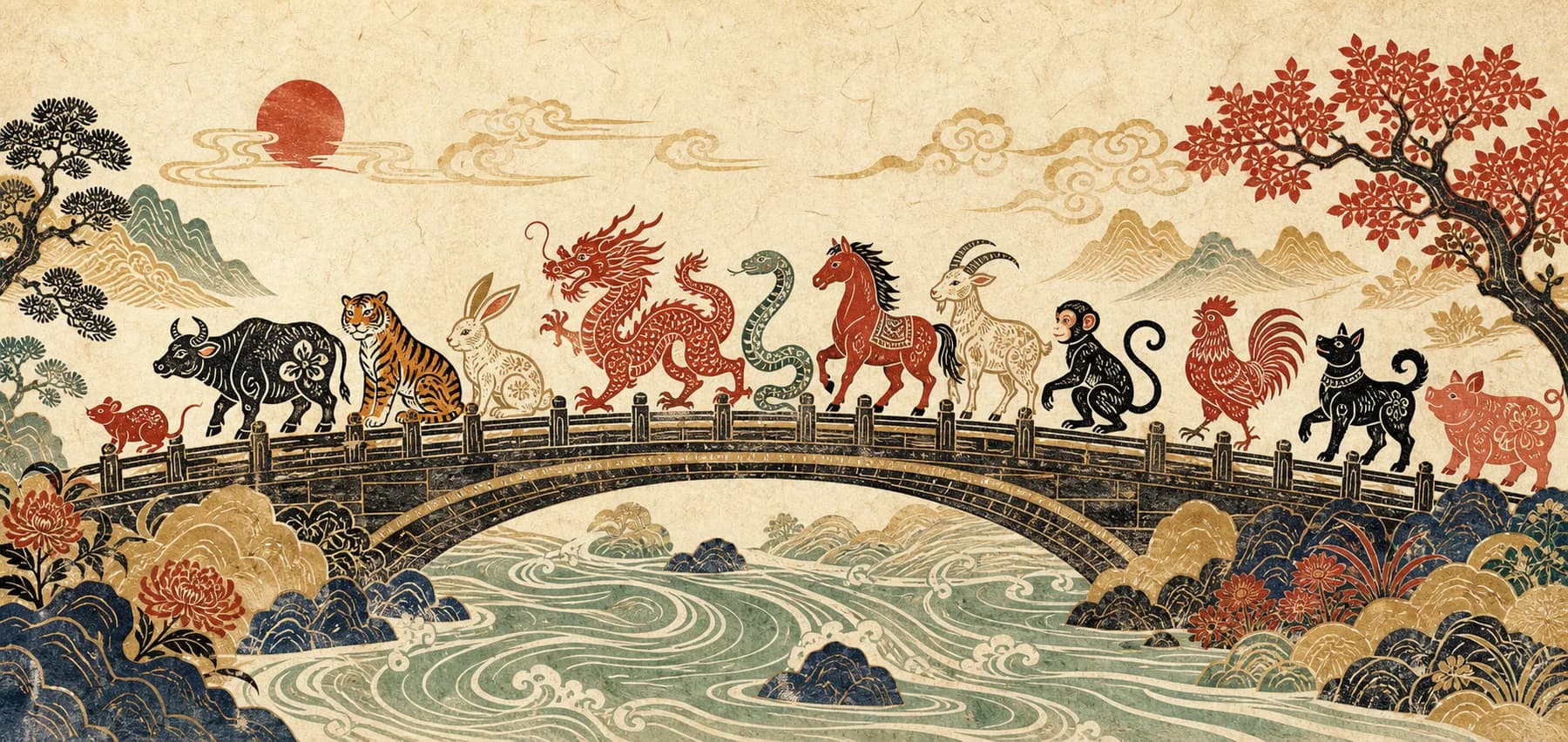
The fixed procession
The order the story explains
Whatever the variant, the animals always finish in the same sequence — the fixed order of the twelve Earthly Branches.
子 Zi branch
Too small to cross the river…
丑 Chou branch
Steady in the current and willing to carry pas…
寅 Yin branch
A powerful swimmer that fought the current the…
卯 Mao branch
Unable to swim the distance…
辰 Chen branch
The only racer that could have flown the river…
巳 Si branch
Coiled unnoticed around the Horse's hoof for t…
午 Wu branch
Fast enough to place far higher and undone at …
未 Wei branch
One of three who found a raft and crossed toge…
申 Shen branch
Cleared the weeds that fouled the raft and pus…
酉 You branch
Spotted the raft in the first place…
戌 Xu branch
The strongest swimmer in the field…
亥 Hai branch
Grew hungry on the way…
From summons to final arrival
Common narrative structure
- An authority — often the Jade Emperor, sometimes the Buddha — summons the animals to a race, banquet or selection.
- The Rat reaches the finish first, usually through ingenuity and a ride on the Ox's back, leaping ahead at the last moment.
- The other animals arrive in the order later associated with the twelve branches, each delayed by a characteristic adventure.
- The Pig, unhurried, completes the group — which is why it closes the cycle.
One order, many tellings
Alternate retellings
Versions differ about who judged the contest, whether a river had to be crossed, why the Cat was tricked out of the cycle, why particular animals arrived late, and what the contest rewarded. Some retellings explain grudges — Cat and Rat, or Rooster and Monkey — while others focus on the order alone.
Beyond the race
The other stories the cycle carries
The race explains the order. These explain the things the order is used for — and one of them explains why the cycle looks different a border away.
The cat, and why it is not here
In most tellings the Cat and the Rat are friends who agree to wake each other for the summons. The Rat does not, and arrives without it. That is the story's answer to a question children ask immediately — the cat is a familiar animal, so why is it absent — and it doubles as an explanation for why cats chase rats and dislike water. The plainer answer is that domestic cats reached China well after the cycle was fixed.
In Vietnam the fourth animal is the Cat
The Vietnamese zodiac runs Rat, Ox, Tiger, Cat — not Rabbit — and is otherwise the same twelve. The usual explanation is phonetic: the fourth branch is 卯, mǎo in Chinese, which is close to mèo, the Vietnamese word for cat. The branch travelled intact and the animal attached to it did not, which is a useful reminder that the animals are labels on a cycle rather than the cycle itself.
本命年 — your own year, and the red thread
A person's own animal year, returning every twelfth year, is traditionally the risky one rather than the fortunate one. The custom is to wear something red through it — a belt, a cord, socks, underclothes — often given by a family member rather than bought for oneself. It is one of the few pieces of Chinese astrology that is still widely practised as a matter of course, and it turns the cycle from a label into something with a date attached.
太歲 — the year that stands opposite
Behind the benmingnian custom sits Tai Sui, the deity of the year, associated with the counter-orbit of Jupiter. Being in one's own year is described as sitting with Tai Sui; the year opposite — the branch six places away, the same clash the charts report — is described as offending it. The relation the calculation prints as 冲 and the relation the folklore treats as a year to be careful in are the same position on the same circle.
Jupiter, and why twelve
The twelve is not arbitrary and does not come from the animals. Jupiter takes close to twelve years to return to the same place among the stars, and early Chinese astronomers divided the sky into twelve stations along its path. The animals were fitted to a division the sky had already made — which is why the cycle is twelve long rather than ten, or twenty.