Eight figures · sixty-four changes
I Ching & Chinese Astrology: 8 Trigrams, 64 Hexagrams
8 trigrams combine into 64 hexagrams. Explore their Yin/Yang lines, Five Phases, directions and the distinction between a hexagram and a birth chart.
Cast coins or enter changing lines → · Browse all 64 hexagrams →
- Line states
- 2 · yin and yang
- Three-line figures
- 8 · trigrams
- Six-line figures
- 64 · hexagrams
Three lines · eight figures
Read the eight trigrams as a compact atlas
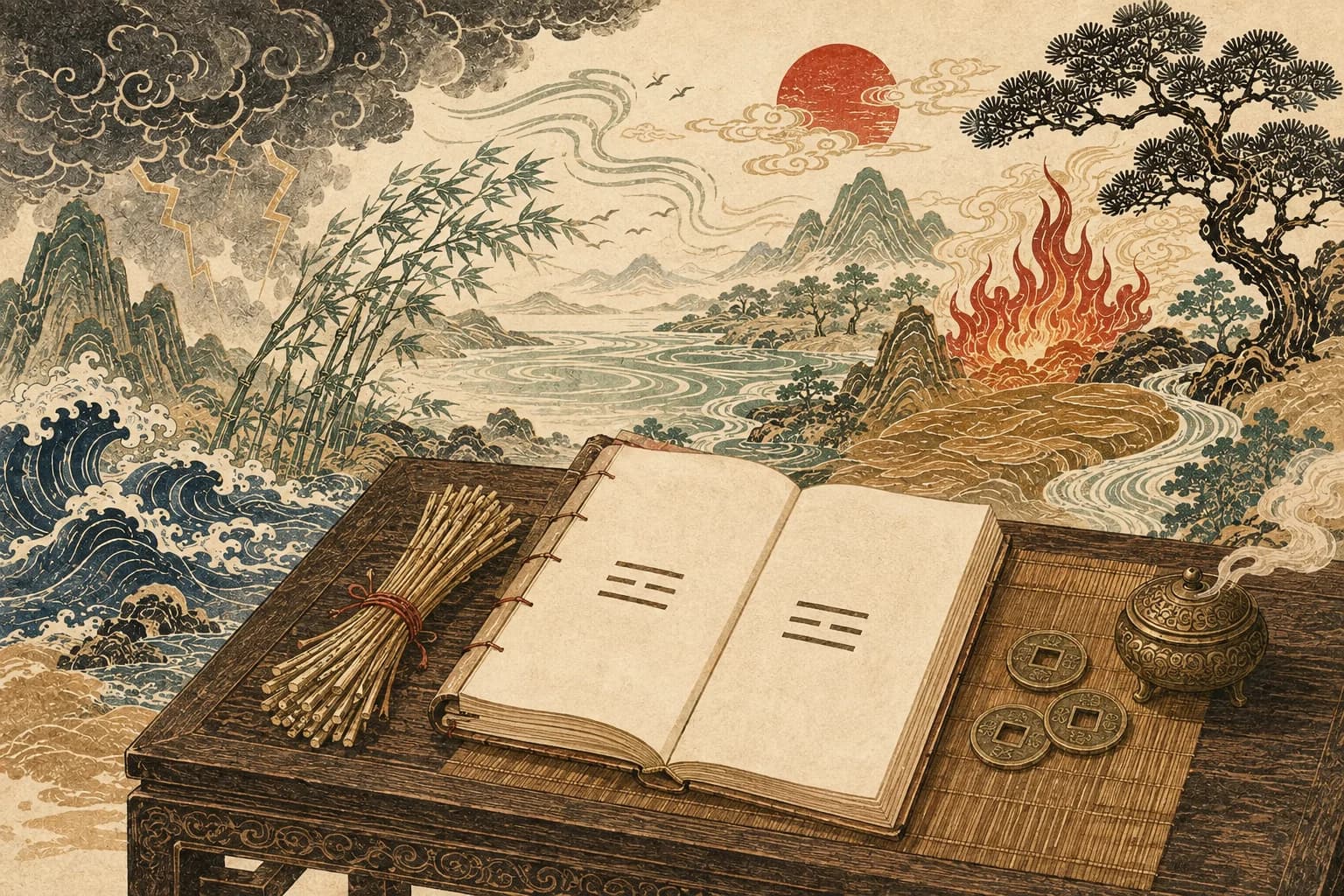
Three stacked lines, each solid (yang) or broken (yin), give eight figures. Every one carries an image, a Later Heaven direction and a phase as well as a name.
- 01
North-west
乾 Qián
Heaven · the creative — unbroken strength
Metal phase → - 02
West
兌 Duì
Lake · the joyous — an open surface
Metal phase → - 03
South
離 Lí
Fire · the clinging — brightness holding to what it burns
Fire phase → - 04
East
震 Zhèn
Thunder · the arousing — the shock that starts movement
Wood phase → - 05
South-east
巽 Xùn
Wind · the gentle — entering everywhere
Wood phase → - 06
North
坎 Kǎn
Water · the abysmal — flowing into danger
Water phase → - 07
North-east
艮 Gèn
Mountain · keeping still — the limit reached
Earth phase → - 08
South-west
坤 Kūn
Earth · the receptive — yielding and carrying
Earth phase →
One set · two arrangements
Why it matters which circle you are reading
The same eight figures are set out in two different circles. Mixing them places every direction wrongly.
Earlier Heaven
A symmetrical field of opposites
Attributed to Fu Xi: every trigram faces its exact opposite, so Heaven sits against Earth and Fire against Water. It is read as a diagram of how things are constituted rather than how they move, and is the arrangement usually shown in discussions of the Changes as a system.
Later Heaven
A seasonal sequence of movement
Attributed to King Wen: it follows the turning seasons, with Thunder in the east where spring begins and Fire in the south at summer's height. This is the arrangement a feng shui compass uses, and the directions in the atlas above are its.
Shared terms · separate structures
Where the Changes meets the calendar
The Changes and the calendar traditions share yin, yang and five-phase vocabulary, then apply it to different structures.
Polarity does different work
In a chart, polarity belongs to the ten heavenly stems and alternates strictly, so stems and branches of opposite parity never pair. In the Changes, a line is yin or yang in its own right and can change into the other; that changing is the subject.
See the chart structure →The five phases form the bridge
Each trigram has a phase. Those assignments let a feng shui practitioner read a direction as Wood or Metal and apply generating and controlling cycles to a room. The phases are shared; the structures laid over them remain separate.
Follow the five phases →Two ways of arranging change
The Changes follows transformation through hexagrams. The calendar follows years, months, days and hours through stems and branches. Both use paired opposites, which is why some vocabulary appears in each.
Read the calendar boundaries →